
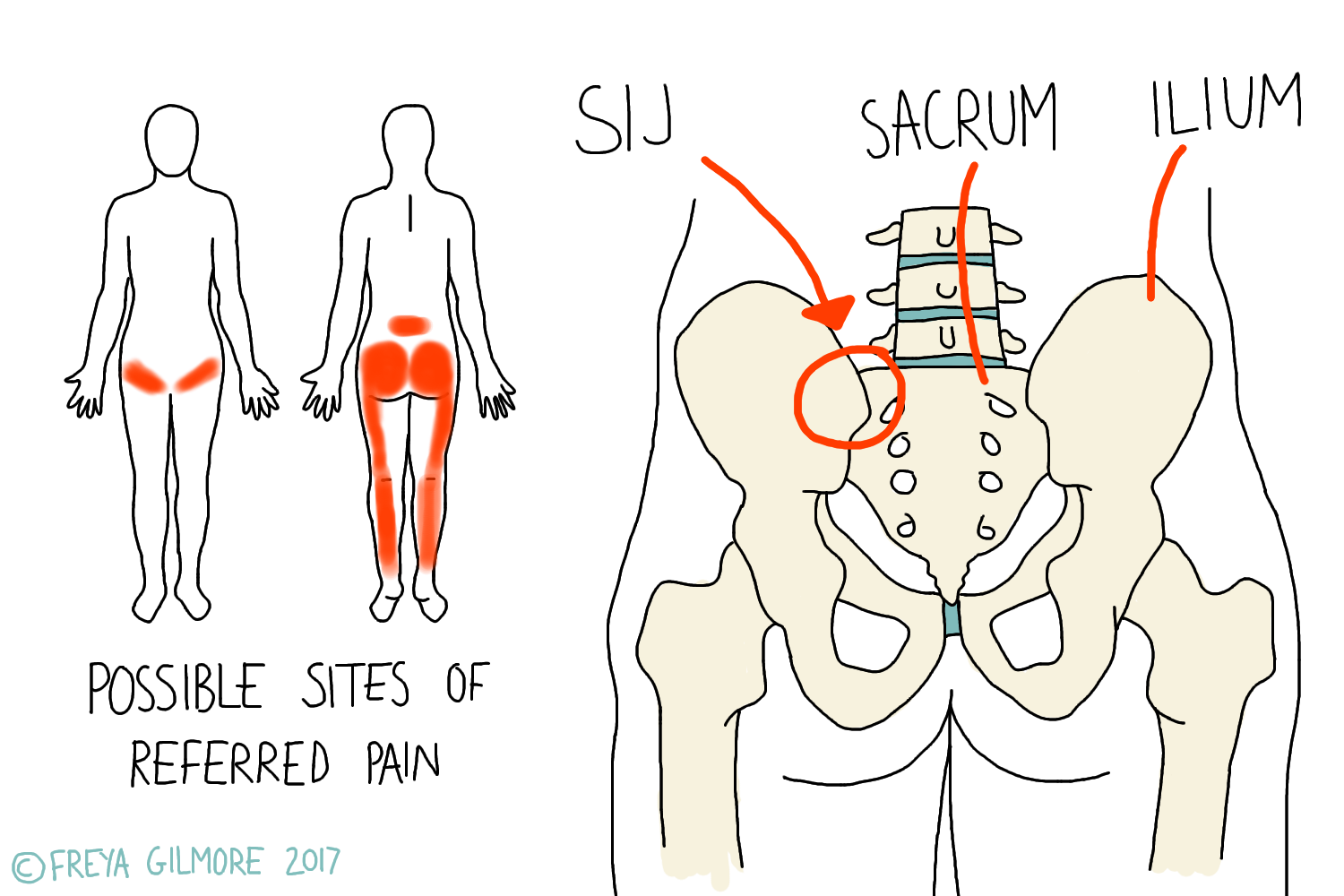
🔍 Understanding Sacroiliac Joint Dysfunction (SIJD)
The sacroiliac joints (SIJs) are paired joints between the sacrum and ilium of the pelvis. They play an important role in transferring loads between the spine and lower limbs, providing stability while allowing small movements that absorb force (Vleeming et al., 2012). When dysfunction occurs—whether through altered mechanics, ligament strain, or muscle imbalance—it can result in pain, reduced movement, and compensatory issues in the lumbar or hip regions.
Why It Matters
Low back pain is one of the most common causes of disability worldwide. The World Health Organization (2023) estimates that over 619 million people globally were affected in 2020, a number projected to reach 843 million by 2050. In Australia, around 16% of people—roughly four million—live with back problems (AIHW, 2023). Research suggests the sacroiliac joint is the source of pain in approximately 10–25% of chronic low back pain cases (Miller & Patel, 2020) and may contribute to up to 15–30% of idiopathic low back pain presentations (Cohen et al., 2013).
Because SIJ-related pain often overlaps with lumbar and hip pathology, it is frequently under-recognised or misdiagnosed (Polly et al., 2021).
🩺 Diagnosing SIJ Dysfunction
Diagnosis can be challenging due to symptom overlap. Clinical tests such as distraction, compression, thigh thrust, and Gaenslen’s are used to reproduce pain. When three or more are positive, sensitivity can reach 91% and specificity 78% (Majlesi et al., 2008; Arab & Abdollahi, 2010). However, reliability varies, and diagnostic imaging or image-guided blocks may be required to confirm diagnosis (DePalma & Ketchum, 2011).
Typical signs include unilateral low-back or buttock pain that may radiate into the posterior thigh, aggravated by sitting, standing, or stair climbing (Laslett, 2008). Pain rarely centralises (as seen in discogenic pain), and patients may report asymmetry or difficulty lifting the leg due to pelvic instability.
🏋️ Evidence-Based Management
A multimodal approach combining manual therapy, exercise, and education is recommended for most patients (Qaseem et al., 2017). Exercise programs that emphasise core and gluteal activation, hip stability, and lumbopelvic control are central to recovery (Li et al., 2023).
Manual therapy—mobilisation or manipulation of the SIJ and surrounding structures—has demonstrated improvements in function, though evidence for long-term pain relief remains limited (Li et al., 2023; Laslett, 2008). A recent meta-analysis found significant reductions in both pain (SMD = −1.07) and disability (SMD = −0.99) following physiotherapy interventions for SIJD (Li et al., 2023).
Other useful adjuncts include pelvic belts for hypermobility, ergonomic adjustments, and load-management strategies in occupational settings (Polly et al., 2021). Persistent or refractory cases may benefit from interventional procedures such as corticosteroid injections or radiofrequency ablation, though conservative physiotherapy remains first-line (DePalma & Ketchum, 2011).
💡 Application in Practice
In physiotherapy—particularly in rural and industrial sectors where repetitive lifting and vibration exposure are common—early recognition and management of SIJD are essential. Screening workers presenting with lumbopelvic pain using provocation tests and functional assessments can identify SIJ involvement early.
Treatment should combine manual therapy, targeted strengthening, and ergonomic intervention to restore load transfer and prevent recurrence. Education on posture, lifting mechanics, and self-management empowers patients to maintain improvements and reduce flare-ups (Laslett, 2008; Qaseem et al., 2017).
📌 Summary
Sacroiliac joint dysfunction accounts for a significant proportion of low-back and pelvic pain cases—estimated between 10% and 25% of chronic presentations. Physiotherapy interventions, including manual therapy and exercise, have proven effective for improving pain and function. By integrating evidence-based assessment, active rehabilitation, and ergonomic strategies, clinicians can help patients recover faster and sustain long-term pelvic stability.
References
Australian Institute of Health and Welfare. (2023). Back problems. Australian Government. https://www.aihw.gov.au/reports/chronic-musculoskeletal-conditions/back-problems
Arab, A. M., & Abdollahi, I. (2010). Assessment of the validity of clinical tests for sacroiliac joint dysfunction. Pain Physician, 13(2), 135–143.
Cohen, S. P., Chen, Y., & Neufeld, N. J. (2013). Sacroiliac joint pain: A comprehensive review of epidemiology, diagnosis, and treatment. Anesthesia & Analgesia, 117(1), 69–84. https://doi.org/10.1213/ANE.0b013e3182915d9a
DePalma, M. J., & Ketchum, J. M. (2011). Diagnosis and treatment of sacroiliac joint pain. Pain Medicine, 12(6), 875–889. https://doi.org/10.1111/j.1526-4637.2011.01185.x
Laslett, M. (2008). Evidence-based diagnosis and treatment of the painful sacroiliac joint. Journal of Manual & Manipulative Therapy, 16(3), 142–152. https://doi.org/10.1179/jmt.2008.16.3.142
Li, L., Zhang, W., Sun, Z., & Guo, H. (2023). Efficacy of physiotherapy interventions for sacroiliac joint dysfunction: A systematic review and meta-analysis. Journal of Back and Musculoskeletal Rehabilitation, 36(4), 693–706. https://doi.org/10.3233/BMR-220133
Majlesi, J., Ünalan, H., & Toprak, S. (2008). The sensitivity, specificity and predictive values of clinical tests for sacroiliac joint dysfunction. Pain Physician, 11(5), 667–676. (some issues cite 667–676 / 669–676 — match to your copy)
Polly, D. W., Cher, D. J., & Wine, K. D. (2021). Sacroiliac joint dysfunction: Review of diagnosis and treatment. World Journal of Orthopedics, 12(11), 900–918. https://doi.org/10.5312/wjo.v12.i11.900
Qaseem, A., Wilt, T. J., & McLean, R. M. (2017). Noninvasive treatments for acute, subacute, and chronic low back pain: A clinical practice guideline from the American College of Physicians. Annals of Internal Medicine, 166(7), 514–530. https://doi.org/10.7326/M16-2367
Vleeming, A., Schuenke, M. D., Masi, A. T., Carreiro, J. E., Danneels, L., & Willard, F. H. (2012). The sacroiliac joint: An overview of its anatomy, function and potential clinical implications. Journal of Anatomy, 221(6), 537–567. https://doi.org/10.1111/j.1469-7580.2012.01564.x
World Health Organization. (2023). Low back pain. https://www.who.int/news-room/fact-sheets/detail/low-back-pain